From October to December 2024, Singapore recorded at least 656 reports involving phished card credentials added to mobile wallets, with losses of at least S$1.2 million. The Singapore Police Force reported that these credentials were then used for unauthorized contactless and online transactions.
AI fraud detection for banking combines machine learning, behavioral analytics, and transaction data to identify unusual activity as it happens. This article explains how banks can use AI for real-time fraud monitoring, stronger AML controls, and measurable risk outcomes.

AI fraud detection for banking monitoring suspicious digital transactions in real time
What AI Fraud Detection for Banking Does Across Fraud and AML Controls
AI fraud detection for banking analyzes patterns across transactions, accounts, devices, locations, and historical behavior. It helps banks identify suspicious activity while giving fraud and AML teams more context for deciding what requires immediate action or investigation.
For fraud detection, a traditional rule might flag every transfer above a fixed amount. An AI model can also assess transaction timing, destination, frequency, device changes, beneficiary behavior, and recent account activity. This broader context helps distinguish unusual behavior from legitimate transactions.
Banks can use these signals to assign risk scores to transactions or accounts. Higher-risk events can trigger additional authentication, temporary controls, or investigation, while known rules continue to address established fraud scenarios.
How AI strengthens AML monitoring and investigation
AML controls have a different objective from immediate fraud prevention. They look for transaction patterns, relationships, and account behavior that may indicate money laundering or movement of illicit funds.
AI can support transaction monitoring by finding unusual patterns across multiple transactions rather than assessing each payment in isolation. It can also help identify suspicious networks by connecting accounts, beneficiaries, transaction flows, devices, or counterparties that share relevant risk signals.
Alert prioritization is another important use case. Instead of treating every triggered rule equally, models can rank alerts using transaction behavior, account history, and related indicators. Investigators can then focus first on cases with stronger combinations of risk signals.
During case investigation, AI can help organize transaction histories and surface related activity for review. Human investigators remain responsible for evaluating the evidence, documenting decisions, and applying the bank’s regulatory procedures.
Fraud detection and AML therefore overlap in data and analytics, but they serve different control objectives. Real-time fraud monitoring aims to interrupt suspicious activity quickly, while AML monitoring supports broader detection, prioritization, and investigation of potentially illicit financial behavior.
Why Real-Time Fraud Detection AI Changes the Risk Response
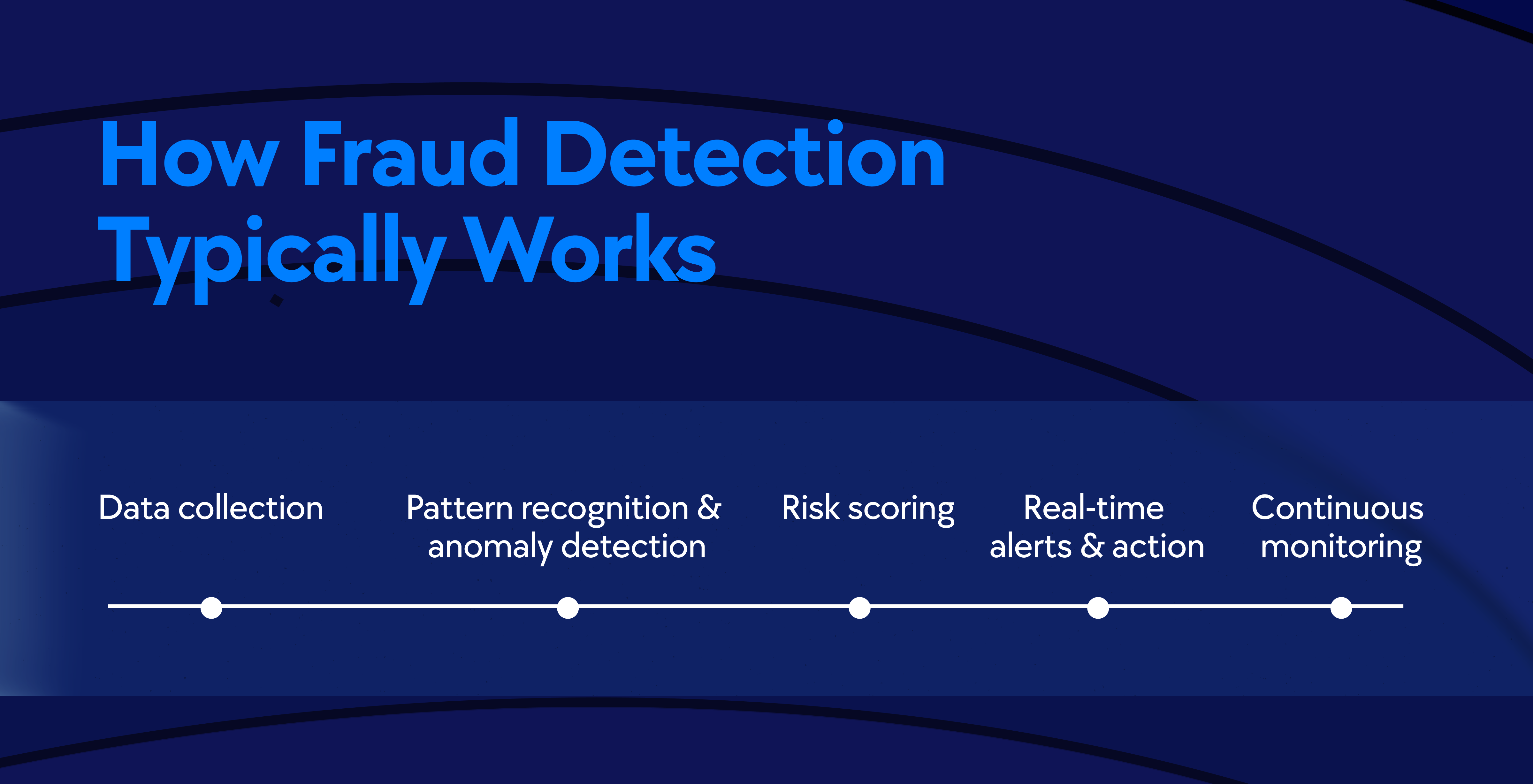
Real-time fraud detection AI shortens the period between a suspicious action and a bank’s response. Models can score transaction events as they enter the monitoring environment instead of waiting for scheduled reviews.
Speed matters because fraud rarely depends on one isolated signal. A new device may not be suspicious alone. A new device followed by unusual transfers and a new beneficiary creates a stronger risk pattern.
Risk scoring helps banks prioritize these combinations. Higher-risk events can move to investigation queues faster, while lower-risk activity can continue through normal controls.
This approach can also reduce unnecessary alerts. Models can compare each event with historical account behavior and related contextual signals. That gives investigators more information than a single threshold breach.
The Singapore Police Force reported that proactive interventions helped avert at least S$348 million in potential scam losses during 2025. More than 32,800 alerts were sent to over 26,000 potential victims.
Those figures do not measure AI performance. They show why earlier detection and intervention matter while suspicious transfers may still be stopped.
For AI fraud detection for banking, response latency should therefore become a core operating metric alongside precision, recall, and false-positive rates.
Four Requirements for an Effective AI-Powered AML Approach
An effective AI-powered anti-money laundering approach needs reliable data, explainable decisions, strong governance, and measurable performance. Models alone cannot fix fragmented transaction monitoring or inconsistent client records.
-
Build reliable transaction and client data foundations
Fraud and AML models depend on consistent information across payment systems, account histories, KYC data, devices, and digital channels.
Banks should define data ownership, lineage, quality rules, and update frequency before model deployment. Missing or inconsistent fields weaken both detection performance and investigation quality.
-
Combine models with explainable risk rules
Compliance teams need to understand why an account or transaction received a high-risk score. A model that produces an alert without usable context creates another investigation problem.
Banks should expose the strongest contributing signals where possible. They should also retain deterministic rules for known scenarios, regulatory requirements, and high-confidence controls.
-
Design security and compliance into the AI environment
Fraud data contains sensitive financial and personal information. Access controls, encryption, audit logs, deployment boundaries, and model governance must be defined before production use.
CMC also maintains security and privacy credentials including ISO 27001:2022, SOC 2 Type II, PCI DSS, and ISO 27701:2019.
CMC APAC delivered a Singapore BFSI engagement with less than one-second time to insight and 100% secure on-premise deployment. These figures demonstrate our capability in secure, low-latency AI environments, rather than fraud-detection outcomes.
-
Measure performance against operational risk KPIs
Banks should measure more than model accuracy. Useful KPIs include precision, recall, false-positive rate, alert-to-case conversion, investigation time, detection latency, and model drift.
Fraud-loss prevention can provide an additional business metric when attribution is reliable. AML teams can also track alert quality and investigation efficiency.
These controls help an AI fraud detection for banking program remain useful after deployment, rather than becoming another unmanaged model.
Financial crime investigation using transaction analytics for fraud and AML monitoring
Frequently Asked Questions
How does AI detect banking fraud in real time?
AI models score transactions using signals such as amount, frequency, device, location, beneficiaries, and historical account behavior. Unusual combinations can receive higher risk scores and trigger additional controls or investigation.
Can AI replace rule-based fraud detection systems?
AI should usually complement rather than eliminate rules. Fixed rules remain useful for known scenarios, while machine learning can detect complex or changing behavioral patterns.
How does AI support anti-money laundering in banks?
AI can identify unusual transaction patterns, rank alerts by risk, and connect signals across accounts or payment activity. This can help investigators focus on cases with stronger indicators of suspicious behavior.
What metrics should banks track when using AI for fraud detection?
Banks should track precision, recall, false-positive rates, detection latency, investigation time, and alert-to-case conversion. Model drift should also be monitored because fraud patterns and client behavior change over time.
What data does AI-powered fraud detection require?
Effective fraud detection works best with consistent transaction histories, account profiles, device information, channel data, and relevant behavioral signals. Banks also need reliable data lineage and controls for sensitive information.
Real-Time AI Makes Fraud Controls More Responsive and Defensible
For banks, effective AI fraud detection for banking requires more than accurate models. It needs secure technology that can support real-time decisions while meeting strict governance requirements. CMC APAC brings this capability to APAC clients through CMC’s C.OpenAI ecosystem, built on 25 core technologies. CMC’s facial recognition technology was also ranked 12th globally by NIST, demonstrating the depth of our AI capability.
CMC was also named a Bronze Stevie® Winner at the 2025 Asia-Pacific Stevie Awards for the AIX-DX Consulting Model. These recognitions support our ability to combine technology depth with enterprise execution.
Banks evaluating fraud detection AI can begin with a focused assessment of data, controls, integration points, and measurable KPIs. Explore our AI Services to discuss the right starting point.