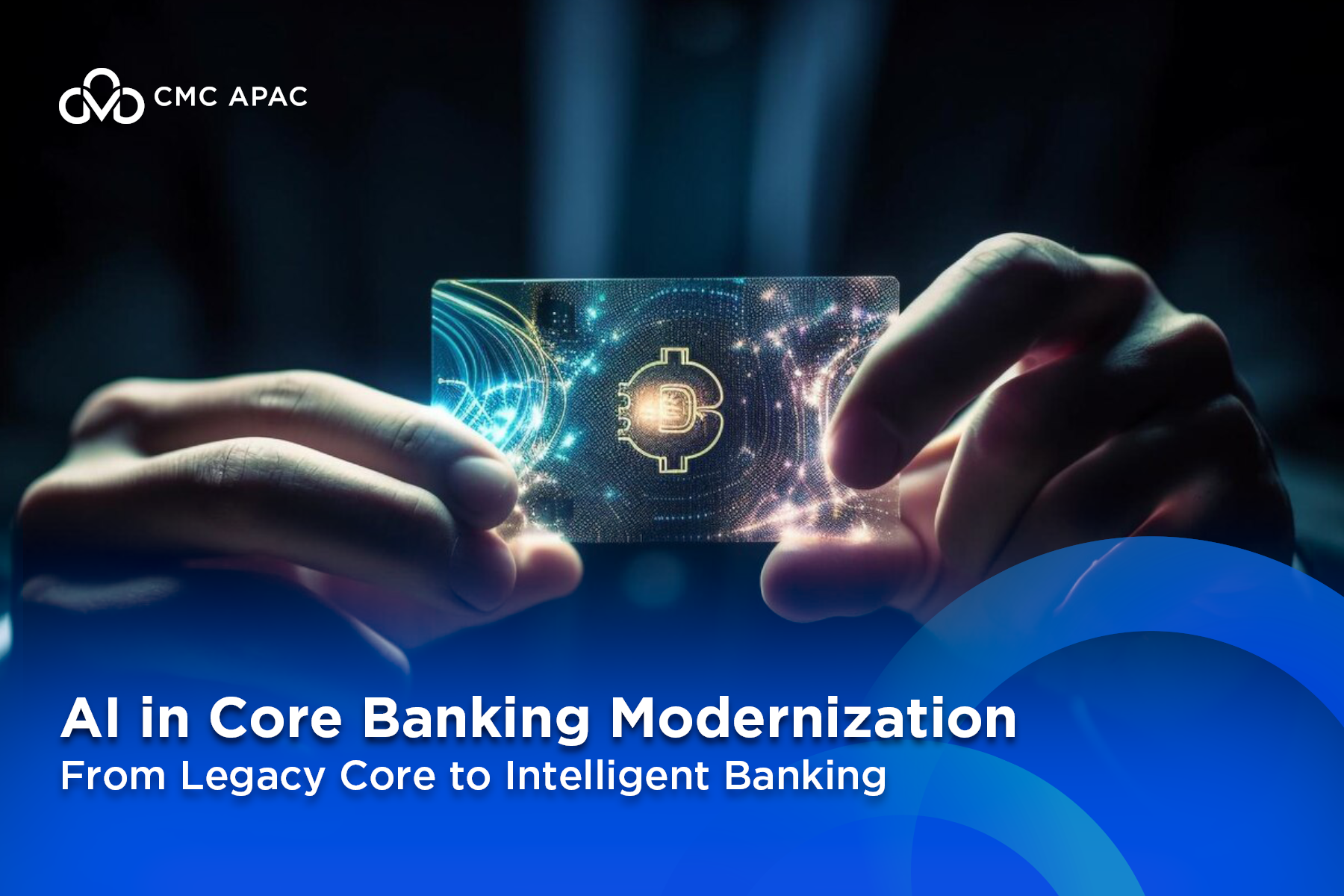
Successful core banking transformations can generate value within 12 to 24 months, according to McKinsey’s 2026 core banking analysis. AI in core banking modernization can extend that value through faster decisions, intelligent processing, and more responsive banking operations.
The challenge is introducing intelligence without weakening systems that protect balances, transactions, and regulatory records. This article explains where AI fits, which use cases matter, how to integrate it safely, and which metrics banks should track.

AI in core banking modernization supporting digital payment transactions
AI Adds an Intelligence Layer Around the Banking Core
A bank does not need to replace every core component before introducing AI. AI in core banking modernization works best when intelligence connects to controlled transaction, data, and workflow layers.
The core remains the system of record for accounts, balances, loans, and ledger entries. Secure application programming interfaces (APIs) can expose selected functions without allowing unrestricted access.
Event streams add another integration layer. They publish events such as payment authorization, loan disbursement, or account activity as those events occur. AI models can then assess selected events for anomalies, risks, or next actions.
This approach makes Core banking AI integration progressive. Banks can preserve stable ledger functions while modernizing decision processes around them.
McKinsey describes the emerging banking core as an intelligent financial engine using modular capabilities, real-time data, AI, and analytics. Its 2026 core banking analysis explains this shift in detail.

Core banking AI integration using secure banking infrastructure
Where AI Creates Measurable Value in Core Banking
AI creates measurable value when a bank connects a defined operational problem to a specific AI task. Each use case also needs clear decision boundaries and measurable KPIs.
McKinsey estimates that generative AI could add between $200 billion and $340 billion in annual value across global banking. That represents about 2.8 to 4.7 percent of industry revenues.
Smart transaction processing
Business problem: High transaction volumes can create exception queues, reconciliation delays, and unnecessary manual reviews. Operations teams may spend significant time handling routine cases instead of genuine exceptions.
AI application: Smart transaction processing can classify transactions, detect unusual patterns, predict which cases require investigation, and assist with exception routing. Models can assess transaction attributes and historical behavior before selected cases reach an operations team.
Operational boundary: AI should not replace deterministic ledger controls, settlement rules, or required approvals. Critical posting and balance calculations should remain governed by established banking rules.
Success metrics: Banks can track straight-through-processing rates, exception volumes, processing time, manual touchpoints, and reconciliation turnaround time.
Fraud, risk, and compliance operations
Business problem: Static rules can generate large alert volumes while missing patterns that emerge across transactions or behavioral signals. Investigation teams may therefore spend too much time on low-risk cases.
AI application: AI models can analyze transaction history, account behavior, payment patterns, and risk indicators. They can prioritize alerts and help investigators understand the signals behind a risk score.
Operational boundary: High-risk decisions should retain documented rules, explainability requirements, escalation paths, and human approval. Model output should support regulated decisions rather than become an unexplained final action.
Success metrics: Relevant KPIs include false-positive rates, alert-to-case conversion, investigation time, detection latency, analyst workload, and fraud losses where reliable baselines exist.
Banking operations and employee workflows
Business problem: Employees often lose time searching internal knowledge, processing documents, triaging alerts, and investigating payment issues. Fragmented information adds handoffs and delays decisions.
AI application: AI can retrieve approved knowledge, extract document data, summarize case histories, and assist employees during investigation workflows. These use cases improve information access without changing core ledger logic.
Operational boundary: Employees should remain accountable for decisions involving financial, regulatory, or client impact. AI systems should access only approved data and functions.
Success metrics: Banks can measure time to insight, case-handling time, search time, manual steps, and resolution time. CMC APAC delivered a GenAI Knowledge Hub for a Singapore BFSI client, achieving sub-one-second time to insight and 100% secure on-premise deployment.
That engagement shows why controlled deployment matters where banking data privacy is critical. Our AI services cover secure environment design, integration, adoption, monitoring, and model operations.
A Four-Phase Path to Core Banking AI Integration
AI in core banking modernization needs a clear path from use-case selection to production governance. Each phase should answer a specific implementation question before the bank expands AI into more critical workflows.
Phase 1: Prioritize use cases by value, feasibility, and risk
The first phase determines where AI should be applied. Banks should assess candidate use cases against business value, data readiness, technical feasibility, and regulatory risk.
Start with processes where bottlenecks already have measurable baselines. Transaction investigations, reconciliation, fraud alert triage, and internal knowledge retrieval are practical candidates.
For each shortlisted use case, define the business owner and target KPIs before development starts.
Output: A prioritized use-case portfolio with measurable outcomes, ownership, and risk classifications.
Phase 2: Integrate data, APIs, event flows, and controls
The second phase defines how AI interacts with banking systems. Teams should map required data, APIs, event flows, permissions, and system dependencies.
AI services should remain separated from critical ledger functions when direct access is unnecessary. APIs should expose only the functions required for each approved workflow.
Banks should also define authentication, encryption, data lineage, logging, retention, and model-access controls before production deployment.
Output: An approved integration design documenting data access, system interfaces, security controls, and operating boundaries.

Secure infrastructure supporting AI in core banking modernization
Phase 3: Validate performance, operational fit, and risk
The third phase proves that the use case works under real banking conditions. Model accuracy alone is not enough.
Teams should test latency, exception handling, false positives, reliability, and employee interaction with the workflow. They should examine failures and edge cases alongside successful predictions.
Risk validation should confirm that human approvals, audit logs, escalation routes, and override procedures work as designed.
Output: Evidence that the use case meets agreed business, operational, technical, and risk thresholds.
Phase 4: Scale with ownership, monitoring, and change management
The fourth phase turns a validated use case into a governed production capability. Banks should establish clear ownership for models, data, integrations, processes, and risk controls.
Monitoring should cover model behavior, data drift, processing latency, incidents, and business KPIs. Material model or data changes should follow controlled testing and approval.
Operations teams also need training, updated workflows, and clear responsibilities when AI recommendations conflict with established rules.
Output: A repeatable operating model that lets proven AI capabilities expand without weakening governance.
Frequently Asked Questions
How is AI used in core banking modernization?
AI in core banking modernization adds intelligence to transaction processing, fraud detection, risk workflows, operations, and decision processes. Banks can introduce these capabilities through APIs, event streams, governed data, and controlled AI services.
Does Core banking AI integration require replacing the existing banking platform?
No. Banks can retain stable systems of record while adding modern integration and decision layers around them. Progressive renewal can reduce the operational risk of a single large replacement program.
What is smart transaction processing in banking?
Smart transaction processing applies AI to classify transactions, detect anomalies, prioritize exceptions, and support reconciliation. It reduces unnecessary manual steps while preserving established transaction controls.
Which KPIs should banks track during AI modernization?
Banks should track measures tied directly to the targeted workflow. Common indicators include processing latency, exception rates, manual touchpoints, false positives, resolution time, and straight-through-processing rates.
How can banks manage AI risk around core banking data?
Banks should control data access, record lineage, monitor models, and maintain auditable decision histories. High-risk workflows should also include explainability requirements and defined human approval points.
AI Can Modernize Banking Without Putting the Core at Uncontrolled Risk
AI in core banking modernization requires technical capability and disciplined governance. Through CMC Corporation, we bring the C.OpenAI environment and its 25 core technologies to APAC engagements. CMC’s facial recognition technology ranked 12th globally in NIST testing, providing independent evidence of AI research depth.
Trust matters just as much as model performance in banking. Our global technology partnerships support enterprise integration, while CMC’s 2025 Bronze Stevie® recognition for the AIX-DX Consulting Model demonstrates independently recognized transformation capability.
For banks deciding where AI can improve core operations without introducing uncontrolled risk, we offer an assessment focused on priorities, controls, and measurable outcomes. Discuss your modernization priorities with CMC APAC