Skill gaps are the leading barrier to business transformation, cited by 63% of employers in the World Economic Forum’s 2025 survey. AI staff augmentation services help companies add machine learning specialists without waiting through a long permanent hiring cycle. They close gaps across data engineering, model development, MLOps, and cloud deployment. This article explains the model, compares delivery options, and presents five steps for building a productive AI team. Source: World Economic Forum, Future of Jobs Report 2025
What Are AI Staff Augmentation Services?
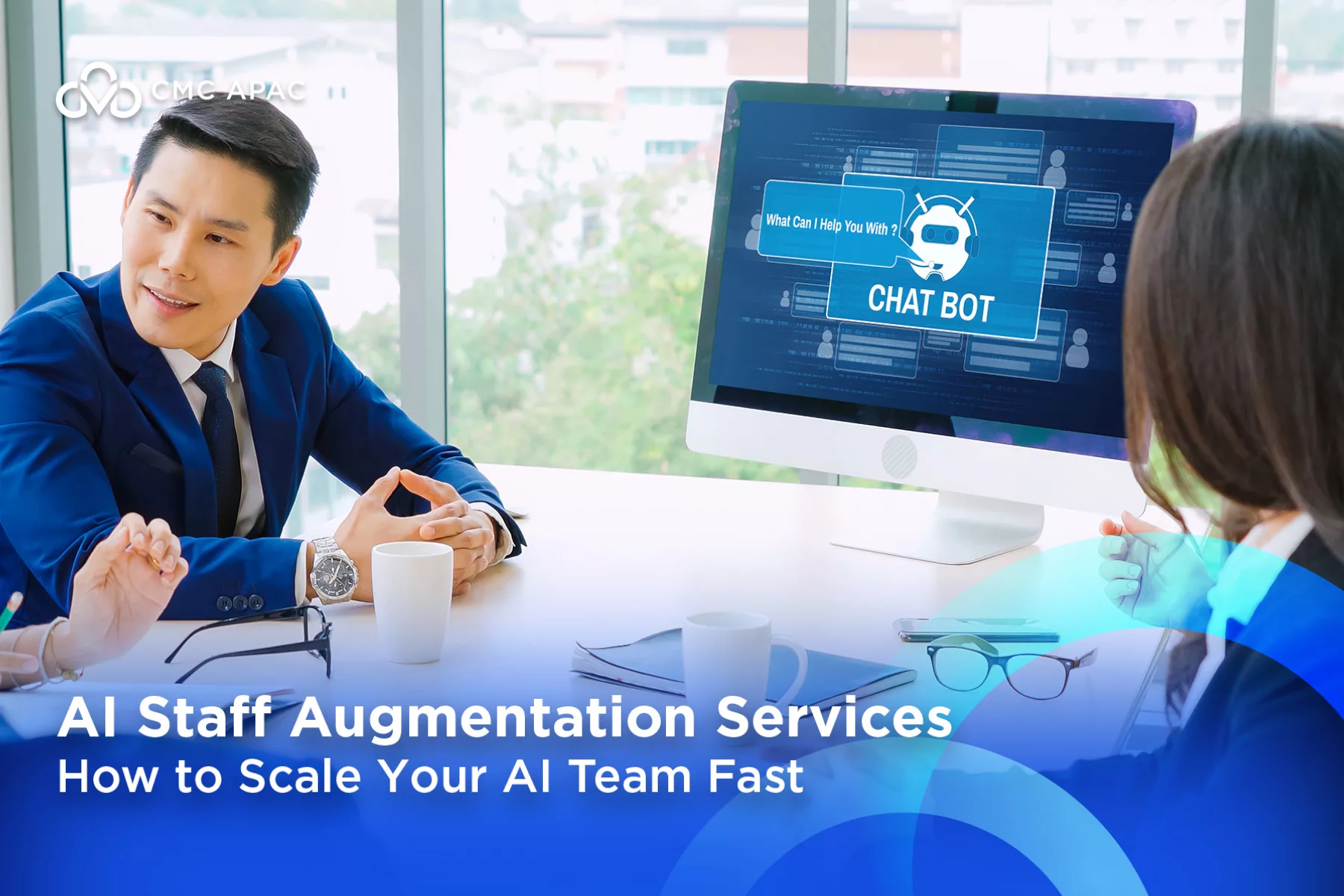
AI staff augmentation services add specialist AI and machine learning professionals to an existing team for a defined capability need. The client keeps control of priorities, technical direction, and daily work.
Common roles include Machine Learning Engineers, Data Scientists, Data Engineers, MLOps Engineers, Computer Vision Engineers, and GenAI Engineers. Each role addresses a different delivery bottleneck.
The model works best when the company already has a product owner, technical lead, and active backlog. An IT Partner then supplies missing skills and supports onboarding, quality controls, and team continuity.
CMC APAC combines its Staff Augmentation model with full-cycle AI services for model development, deployment, data preparation, and integration.
Why Companies Struggle to Scale AI Teams Fast 
Companies struggle to scale AI teams fast because production work requires more than model development. Reliable delivery also needs clean data, cloud infrastructure, monitoring, security, and clear ownership.
Long Hiring Cycles Delay AI Projects
Specialist roles require technical screening and proven deployment experience. Slow recruitment can delay pilots, model releases, and planned automation benefits.
Missing MLOps Skills Create Production Gaps
Data Scientists may build accurate models but lack deployment experience. Teams then struggle with monitoring, retraining, version control, and incident response.
Weak Team Integration Increases Delivery Risk
New engineers need clear ownership, access rules, coding standards, and shared goals. Weak integration creates duplicated work and poor knowledge transfer.
AI Staff Augmentation Services vs Direct Hiring and Project-Based Delivery
AI staff augmentation services suit evolving backlogs that require daily client control. Direct hiring fits permanent leadership roles, while Project-Based Engagement fits stable scope and acceptance criteria.
| Decision factor | AI team extension | Direct hiring | Project-Based Engagement |
| Starting speed | Faster specialist access | Longer recruitment cycle | Depends on scope approval |
| Daily control | High | High | Shared with the IT Partner |
| Capacity changes | Easier to adjust | Limited | Defined by the agreement |
| Best fit | Evolving products | Permanent strategic roles | Clear deliverables |
| Knowledge transfer | Continuous | Fully internal | Planned at milestones |
Hybrid Engagement combines ongoing engineering capacity with defined milestones. It helps companies keep daily control while improving accountability for specific deliverables.
How to Scale Your AI Team Fast with a Five-Step Talent Model
Use the Define → Select → Validate → Integrate → Measure model to add specialist skills without creating unnecessary management work.
Step 1: Define AI Outcomes and Skill Gaps
Start with the business outcome, not a list of job titles. Define the use case, delivery stage, technical dependencies, and success measures.
A forecasting project may need a Data Engineer before it needs another Data Scientist.
Step 2: Select the Right AI Roles
Match each role to the current bottleneck. Use Best-Shore Delivery when internal model-engineering capacity is limited and the business needs additional specialist capability without expanding permanent headcount.
Add an MLOps Engineer when deployment or monitoring causes delays. Add a Data Engineer when data quality blocks model development.
Step 3: Validate Production Experience and Controls
Assess coding, system design, cloud skills, and previous production deployments. Ask candidates to explain model failures, monitoring choices, and security decisions.
Review whether the IT Partner follows ISO 27001:2022, SOC 2 Type II, and defined access-management procedures.
Confirm intellectual property terms, secure repository controls, audit logging, and data-handling responsibilities before onboarding begins.
Step 4: Integrate Engineers into One Delivery Team
Use one backlog, one Definition of Done, and shared coding standards. Assign a product owner and technical lead with clear decision rights.
Include sprint reviews, documentation requirements, and knowledge-sharing sessions. These practices help external engineers work as part of the existing team.

Step 5: Measure Results and Adjust Capacity
Measure outcomes rather than headcount. Track time to the first productive sprint, deployment frequency, model accuracy, and escaped defects.
Also track knowledge transfer, incident rates, milestone completion, and total delivery spend. Adjust the team when priorities or technical needs change.
AI Staff Augmentation Services Business Outcomes and KPIs
AI staff augmentation services can shorten access to specialist skills while keeping product ownership inside the business.
Microsoft’s 2025 Work Trend Index found that 78% of leaders were considering AI-specific roles. These include AI trainers, data specialists, security specialists, AI agent specialists, and ROI analysts. Source: Microsoft, 2025 Work Trend Index
CMC APAC provides access to more than 200 AI professionals with over 500 certifications across AWS, Azure, GCP, and NVIDIA. Pre-built accelerators may reduce AI deployment time by up to 30%. Production-ready pilots can take four to six weeks.
Leaders should compare time to productivity, deployment frequency, and knowledge-transfer completion against the original hiring plan. These measures show whether added capacity creates business value.
AI Team Expansion Frequently Asked Questions
What is the difference between a Data Scientist and an ML Engineer?
A Data Scientist develops and tests models, while an ML Engineer prepares them for reliable production use. Most production systems require both skill sets.
How quickly can a business expand an AI team?
The timeline depends on role availability, assessment, access approval, and onboarding readiness. A prepared backlog and clear skills matrix can shorten the process.
Which AI role should a company add first?
The first role should address the current delivery bottleneck. Choose data engineering, model development, or MLOps skills based on the project stage.
How should businesses evaluate remote ML engineers?
Evaluate coding ability, production experience, system design, model monitoring, and communication. Practical assessments should reflect the company’s technology and use case.
What security controls should an external AI team follow?
External engineers should use controlled access, secure repositories, audit logs, and documented data rules. Access removal and intellectual property responsibilities must remain clear.
When is AI team extension better than a fixed project?
Choose team extension when requirements change frequently and internal leaders need daily control. Fixed projects work better when scope and acceptance criteria are stable.
AI Staff Augmentation Services for Faster, Governed Growth
Speed comes from role clarity, strong onboarding, and measurable delivery controls. Adding more engineers without these foundations only moves the bottleneck.
CMC APAC’s Best-Shore Delivery model combines a Singapore-facing team with a Vietnam engineering hub. It supports clients across Southeast Asia and the broader APAC region.
Build the AI capacity your roadmap requires without extending the permanent hiring cycle. Request an AI team assessment to identify suitable roles, delivery controls, and an engagement model for your next initiative.