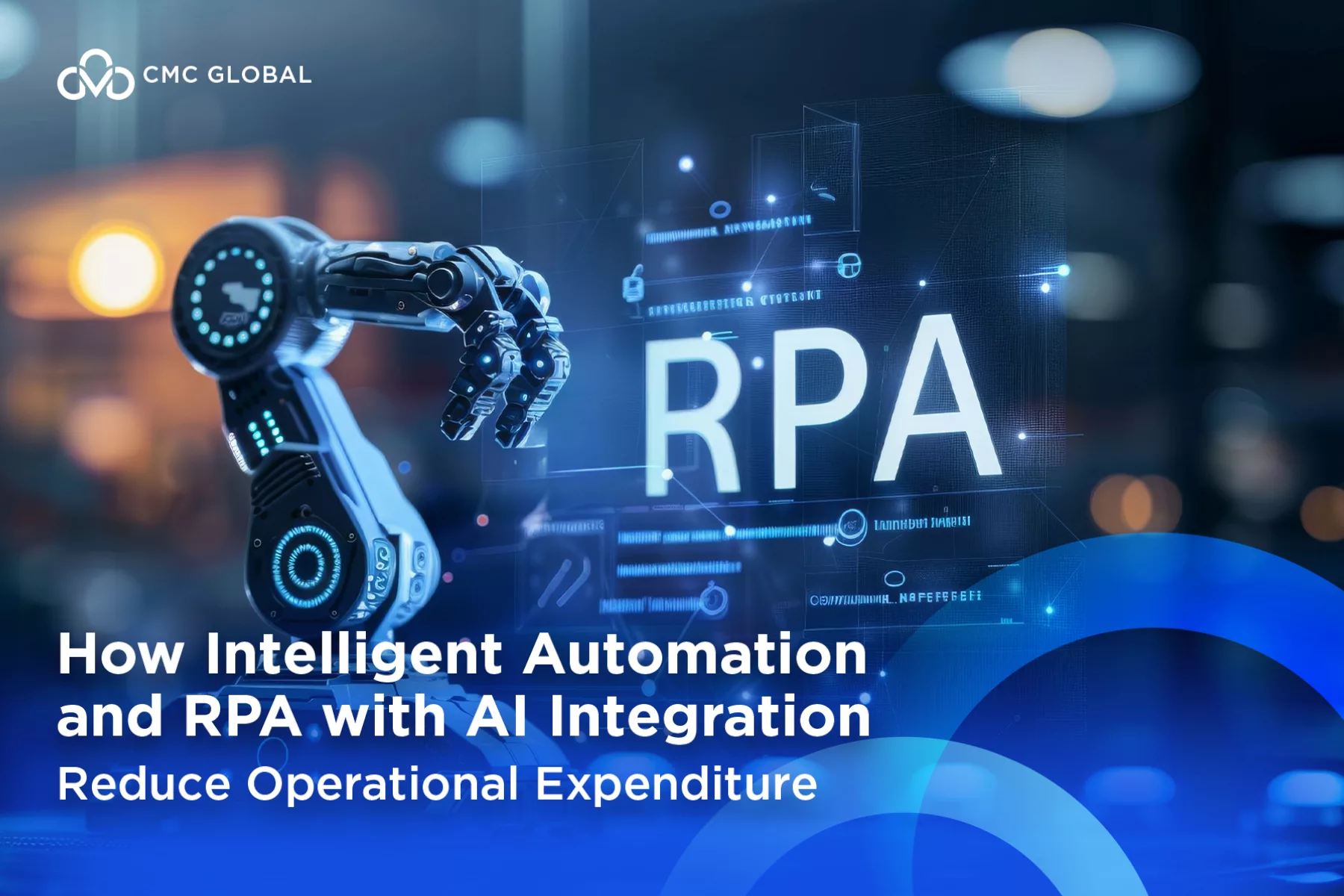
Enterprise cost pressures are driving a major shift toward intelligent automation across the Asia-Pacific region. When basic robotic automation projects slow down, deploying intelligent automation and RPA with AI integration helps companies achieve value-driven cost optimization. This advanced approach transitions manual work streams from basic transactional execution into highly resilient software environments. By deploying smart software, corporate leaders can systematically lower monthly operational expenditure (OPEX) and eliminate legacy application risks.

This strategic analysis provides an executive overview of how organizations use enterprise artificial intelligence to lower data maintenance expenses, minimize processing errors, and eliminate human exception-handling workloads. Specifically, we examine the failure points of legacy process automation and deliver an actionable roadmap to deploy production-ready automation architectures.
What Is Intelligent Automation and Robotic Process Automation?
Intelligent automation is an advanced software approach combining machine learning, artificial intelligence, and robotic process automation to execute end-to-end workflows. This architecture uses multi-step reasoning to evaluate unstructured data sources, adapt to changing business conditions, and continuously optimize process execution.
In contrast, robotic process automation (RPA) acts as a digital mechanism used to record and replay high-volume, rule-based tasks. While RPA excels at mimicking static user actions, it remains constrained by fixed data inputs. It cannot resolve unexpected process anomalies or process data variations independently. Intelligent automation eliminates these technical constraints by embedding artificial intelligence directly into the corporate environment. This framework alignment securely coordinates complex data flows with adaptive cognitive reasoning.
Why Traditional RPA Fails in Modern Enterprise Infrastructure
Traditional RPA models frequently fail within complex, cloud-ready systems because they lack semantic processing and real-time data handling capabilities. Legacy automated tasks rely entirely on static user-interface scripts or rigid decision trees. When an external application layout updates or an internal software schema changes, standard robotic workflows break immediately. This technical gapping creates significant operational risk, slowing down digital transformation projects and increasing data maintenance costs.
Furthermore, basic robotic systems cannot manage unstructured information, which impacts a significant portion of business operations. According to IDC’s White Paper on Enterprise Unstructured Data Analytics, unstructured information represents over 80 percent of modern enterprise operational volume. McKinsey & Company’s global automation research notes that organizations relying solely on basic scripts spend up to 40 percent more on exception-handling overhead. When processing files like scan sheets or raw emails, legacy automation projects stall, forcing teams to use manual intervention. To resolve these engineering bottlenecks, technology leaders must progress to autonomous workflow execution through intelligent automation and RPA with AI integration.
3 Actionable Steps to Execute Intelligent Automation and RPA with AI Integration
Deploying intelligent automation and RPA with AI integration requires a structured, multi-phase methodology that mitigates architectural risk. Technology leaders can systematically transition older legacy applications into resilient automated operations by following these three numbered steps:
Step 1: Conduct an Application Assessment and Process Discovery Phase
Enterprises must first analyze existing business competencies and map technical debt to isolate high-value automation opportunities. This preliminary step evaluates process complexity, data structure variation, and system connection points. To see how this works in practice, global banking leader HSBC utilized advanced process discovery tools to map out its legacy commercial banking pipelines. By identifying invisible operational bottlenecks across separate regional back offices, HSBC targeted specific high-volume tasks for cognitive enhancement before deploying software. Organizations utilize this discovery data to design a clear value proposition workshop and formulate an implementation roadmap.
Step 2: Implement Zero-Trust API Middleware and Private LLM Hosting
To protect sensitive financial and operational data, engineering groups must deploy robust security controls before linking artificial intelligence models. This step establishes a zero-trust API middleware layer to secure real-time data transfers between legacy applications and AI engines. Organizations also establish private LLM hosting environments to prevent data exposure and ensure complete compliance with global privacy regulations. For example, global pharmaceutical leader Pfizer deployed private hosting environments for its generative AI systems. This allowed the company to securely parse unstructured research notes and clinical trials without exposing proprietary IP to public networks, lowering risk.
Step 3: Deploy Task-Specific AI Agents for Autonomous Workflow Execution
The final phase involves embedding task-specific AI agents that run autonomously via large language model orchestration and connected business applications. These intelligent agents dynamically read incoming customer communications, extract semantic metadata using computer vision, and execute workflow actions without disruption.
By connecting these intelligent agents with existing robotic automation loops, companies optimize process speed and accelerate value delivery.
Frequently Asked Questions About Enterprise Automation Upgrades
Q: What is the main differentiator when shifting from legacy RPA to intelligent automation?
Traditional RPA relies on hard-coded rules for execution, whereas intelligent automation embeds AI elements to orchestrate complex data flows, process unstructured documents, and execute multi-step reasoning.
Q: How fast can an enterprise deploy an AI-integrated automation framework?
Through pre-built accelerators, production-ready AI pilots can be fully deployed into enterprise architecture within 4–6 weeks, safely compressing standard deployment timeframes by 30%.
Driving Adaptable Excellence in Enterprise Operations
Gartner’s 2024 Market Guide for Public Cloud Managed & Professional Services, Asia/Pacific notes that enterprise adoption of integrated technical platforms is accelerating to combat operational complexity. As a registered independent entity in Singapore, CMC APAC delivers comprehensive AI services and tailored low-code services that automate up to 70% of routine operations via secure agentic systems. Our Best-Shore Delivery model pairs localized client management with a massive Vietnam engineering hub of 3,000+ experts, ensuring CMMI-DEV Maturity Level 5 software engineering excellence at optimized regional delivery costs. Contact CMC APAC today to schedule a comprehensive process di