Gartner predicts that more than 40% of agentic AI projects will be canceled by 2027 because of rising costs, unclear value, or weak risk controls.
Multi-agent systems for enterprise can avoid this outcome when every agent has a defined role, trusted data, and firm controls. Without these foundations, more agents can create conflicting actions and unclear accountability.
This article explains how to coordinate agents, control risk, and measure results across real business processes.
Source: Gartner, “Gartner Predicts Over 40% of Agentic AI Projects Will Be Canceled by End of 2027,” 2025.
What Are Multi-Agent Systems for Enterprise?
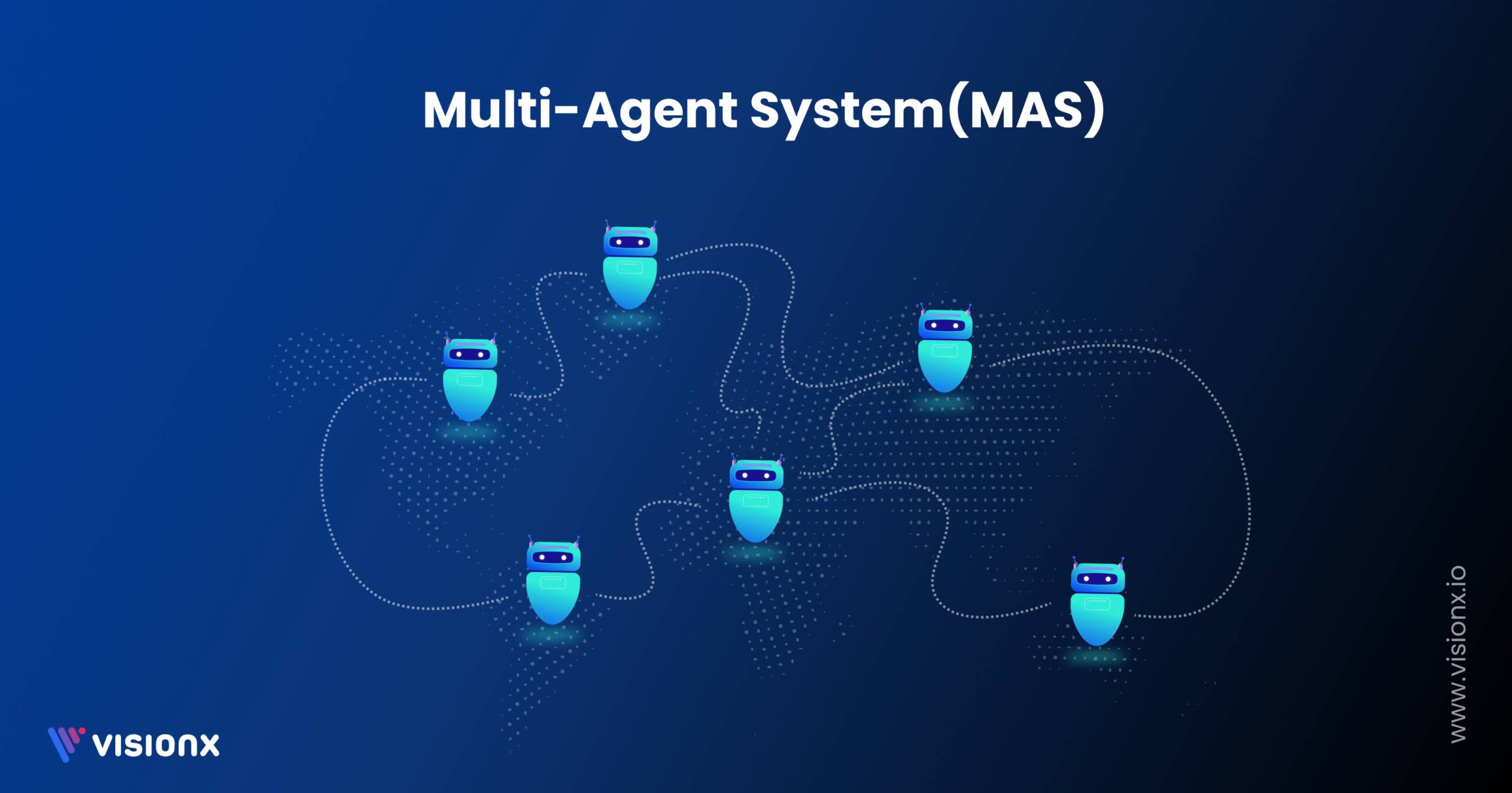
Multi-agent systems for enterprise use several specialized AI agents to plan, review, and complete one shared process.
A manager agent can divide a request into smaller tasks. Worker agents then handle research, data analysis, compliance checks, or system updates.
Each agent has a defined role and limited tool access. Agents share context and pass outputs to the next role. A person reviews sensitive decisions before execution.
| Approach | Best suited for | Main limitation |
| Single AI agent | Simple tasks using limited tools | One agent manages every responsibility |
| Multi-agent system | Complex work with distinct roles | Coordination needs careful controls |
| Fixed automation | Stable, rule-based processes | It adapts poorly to changing context |
How AI Agent Orchestration Coordinates Roles
AI agent orchestration manages task assignment, context sharing, tool access, handoffs, and recovery across connected agents.
The process owner must define who can read data, recommend an action, approve a decision, or update a system.
Why Multi-Agent Systems for Enterprise Need Process Control
Adding agents without redesigning the process increases complexity rather than business value.
McKinsey found that 23% of surveyed organizations were scaling an agentic AI system. Another 39% were experimenting with agents.
Common failures include conflicting data, excessive permissions, failed handoffs, and missing audit records. Teams may also measure agent activity instead of completed business outcomes.
A reliable design needs shared context, controlled tools, clear approval points, and traceable decisions.
Source: McKinsey & Company, “The State of AI in 2025: Agents, Innovation, and Transformation,” 2025.
Where Autonomous AI Workflows Create Business Value
Autonomous AI workflows create value when they complete multi-step work across data, applications, and business teams.
In BFSI, agents can retrieve policies, review documents, check compliance conditions, and route exceptions.
In manufacturing, they can review maintenance history, investigate quality issues, and prepare recommended actions.
In transportation and logistics, agents can assess shipment delays, compare route options, and draft client notifications.
Microsoft reported that 53% of APAC leaders used agents to automate complete workstreams or business processes. The global figure was 46%.
Leaders should measure cycle time, manual effort, accuracy, exception rates, process cost, and payback period.
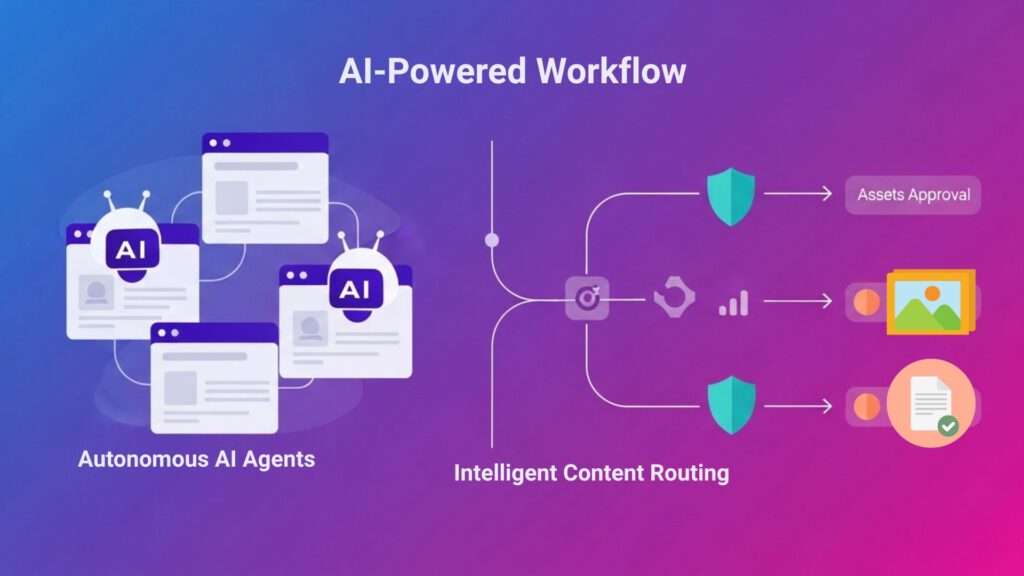
Source: Microsoft, “APAC Emerges as Global AI Frontrunner,” 2025.
A Five-Step AI Agent Orchestration Method
The Define → Connect → Control → Validate → Expand method links technical design with measurable results.
Step 1: Define the Business Outcome
Start with one repeated process that has a clear owner and measurable delays.
Record cycle time, workload, error rate, and process cost. Set boundaries for actions that agents may complete without approval.
Step 2: Connect Agents to Trusted Systems
Give each agent access only to the information and tools required for its role.
Use schema-defined tools and application programming interfaces. Retrieval-Augmented Generation can provide approved knowledge without retraining the underlying model.
Step 3: Control Autonomous Actions
Apply controls before agents can change records, send messages, or trigger transactions.
Use role-based access, least-privilege permissions, stop conditions, and audit logs. Require human approval for financial, regulatory, safety, or client-impacting decisions.
Step 4: Validate the Complete Process
Test the full workflow rather than evaluating each agent separately.
Measure successful handoffs, task completion, accuracy, response time, and escalation quality. Include missing data, conflicting instructions, and unavailable systems.
Step 5: Expand with Measurable Controls
Add new processes only after the first workflow meets its agreed targets.
Reuse approved agent roles, access patterns, testing methods, and monitoring rules. Review every change to models, tools, instructions, and connected data.
CMC APAC’s approved AI evidence includes up to 30% faster deployment and automation of up to 70% of routine tasks. Results depend on the process, data quality, and implementation scope.
How CMC APAC Supports Multi-Agent Systems for Enterprise
CMC APAC combines AI Agent Building, Agentic Automation, data integration, cloud engineering, and private model deployment.
Its AI Services cover business assessment, technical design, pilot execution, integration, monitoring, and ongoing improvement. The approach supports AI ROI, legacy integration, process automation, and governance needs.
CMC APAC delivered a GenAI knowledge hub for a Singapore financial institution. The platform achieved under one-second time to insight through an on-premise deployment.
The case shows how trusted data access and controlled integration can improve knowledge retrieval in a regulated environment.
Frequently Asked Questions About Autonomous AI Workflows
Is a multi-agent system better than a single AI agent?
A multi-agent system is better for complex work with distinct roles, tools, and approval requirements.
A single agent may suit simple, low-risk tasks. Teams should add agents only when role separation improves control or performance.
How is agent coordination different from fixed workflow automation?
Agent coordination supports reasoning and adaptation, while fixed automation follows predetermined rules.
The two approaches can work together. Agents interpret context, while conventional automation completes stable system actions.
Can autonomous AI workflows operate without human approval?
Low-risk actions may run independently, but high-impact decisions need approval and escalation thresholds.
Organizations should base those thresholds on financial value, data sensitivity, and regulatory exposure. Every autonomous action should remain traceable.
How should businesses measure agentic AI ROI?
Measure completed process outcomes rather than model responses or agent activity.
Useful indicators include cycle time, manual effort, accuracy, exceptions, process cost, and payback period. Compare results with a recorded pre-deployment baseline.
Multi-Agent Systems for Enterprise Need Governed Expansion
Multi-agent systems for enterprise create value when agents can coordinate tasks, connect to trusted systems, and complete work within defined controls. At CMC APAC, we support this through AI Agent Building and Agentic Automation. We build task-specific agents with LLM orchestration, tool integration, and workflow execution. We also connect LLMs, APIs, and business rules to support end-to-end autonomous AI workflows.
We can extend this foundation with private LLM hosting, on-premise deployment, and API integration with existing business systems. Our AI team includes 200+ professionals with 500+ certifications across AWS, Azure, GCP, and NVIDIA. Through CMC Global, we also hold Microsoft Solutions Partner for Data & AI and Google Agentspace Partner credentials. Our production-ready AI pilots can launch in four to six weeks using pre-built accelerators. Approved engagement data shows up to 30% shorter deployment time and automation of up to 70% of routine tasks.
We can assess one candidate workflow and define the agents, system connections, controls, and KPIs needed for a production-ready pilot. Explore CMC APAC AI Services to identify a governed starting point for your business.