Deloitte’s 2025 technology outlook put the share of GenAI-using companies launching agentic AI pilots that year at 25%. The report expected that share to reach 50% by 2027.
For leaders assessing autonomous AI agents for business, speed alone is not enough. The decision is whether to use AI agents, Robotic Process Automation, or a hybrid approach for mixed workflows.
This guide explains each option, use cases, controls, KPIs, and a five-step adoption method.
Autonomous AI Agents for Business: Definition and Core Capabilities
Autonomous agents are software systems that pursue goals, select actions, and complete approved tasks with limited human direction.
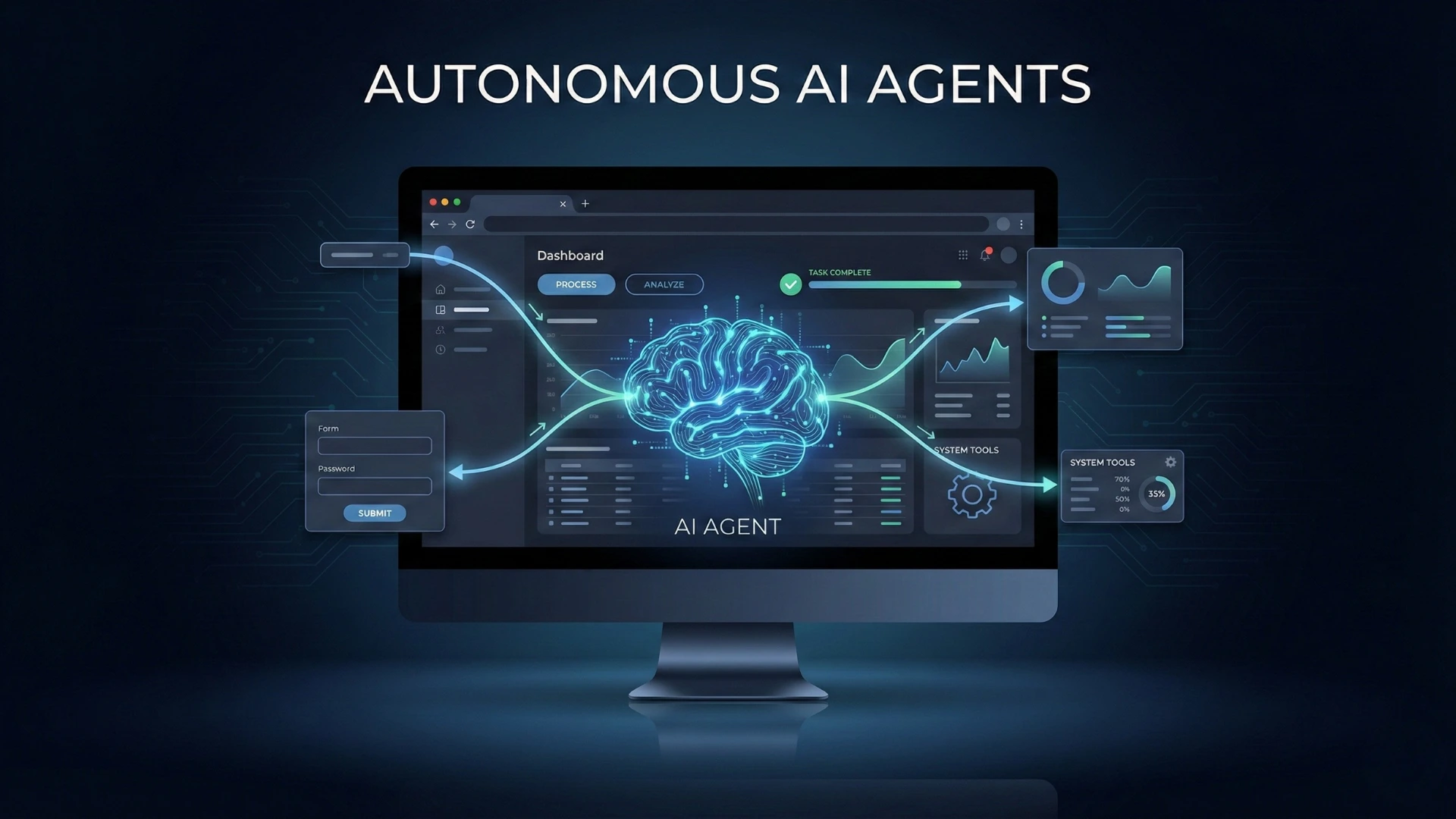
An agent can interpret a request, collect data, call an application programming interface, and update several business systems. It can pause for approval when an action carries financial, legal, or security risk.
Unlike a chatbot, an agent plans a sequence of actions. It also adjusts its next step when new information appears.
CMC APAC’s AI services include AI Agent Building and Agentic Automation. These capabilities combine large language models, tools, APIs, and business rules for multi-step workflow execution.
AI Agents vs RPA: Which Fits Each Process?
The main difference is how each technology handles variation. RPA follows predefined instructions, while an AI agent interprets context before selecting an action.
| Decision factor | RPA | AI agents |
| Best fit | Stable, repetitive tasks | Variable, multi-step work |
| Inputs | Defined fields | Documents, messages, and system data |
| Decisions | Fixed rules | Context-based choices |
| Exceptions | Human escalation | Analysis, action, or escalation |
| System access | Configured interface actions | APIs, tools, and applications |
| Main controls | Bot logs and access rights | Permissions, data, actions, and approvals |
RPA remains effective for data transfer, scheduled reporting, and other predictable tasks. AI agents suit work involving documents, changing conditions, several systems, or frequent exceptions.
Many processes need both. An agent can assess an invoice mismatch, while an RPA bot enters approved data into an older finance application.
Cognitive Automation: How RPA and AI Agents Work Together
Cognitive automation combines rules-based execution with AI capabilities for language, documents, predictions, and decision support.
Consider an accounts-payable workflow. RPA retrieves an invoice and transfers validated fields. AI reads an unusual clause and compares it with purchasing policies.
An AI agent then checks related records, identifies the likely cause, and prepares a recommended action. A manager approves high-risk exceptions before RPA updates the finance system.
This hybrid approach keeps predictable work simple and adds AI only where interpretation is required. Choose it when a process has stable actions but unpredictable inputs.
Use RPA alone when inputs and decisions rarely change. Use an AI agent when the process needs context, judgment, or coordination across several applications.
Autonomous AI Agents for Business: Use Cases and Measurable Results
Autonomous AI agents for business create the most value when they reduce delays across connected tasks, not isolated clicks.
Practical examples include:
- Preparing compliance cases from policies and account records.
- Investigating shipment delays and recommending the next action.
- Coordinating maintenance requests with parts and production schedules.
- Reviewing procurement exceptions before requesting approval.
- Classifying IT incidents and preparing remediation steps.
Microsoft’s 2025 Work Trend Index found that 82% of leaders expected digital labor to expand workforce capacity within 12 to 18 months. (The Official Microsoft Blog)
Useful KPIs include completion time, human intervention, rework, automation rate, cost per case, compliance, and payback period.
CMC APAC reports production-ready AI pilots in four to six weeks. Its accelerators have reduced deployment time by up to 30%. Agentic AI implementations have automated up to 70% of routine tasks.
These figures are CMC APAC delivery outcomes, not universal benchmarks.
Autonomous AI Agents for Business: A Five-Step Adoption Method
Step 1: Assess the process
Map each activity, decision, delay, exception, and system. Set one measurable target, such as shorter handling time or fewer manual reviews.
Remove unnecessary steps before selecting any technology.
Step 2: Select the right approach
Use RPA for stable actions and AI agents for context-heavy work. Combine them when a workflow contains both task types.
Define which actions the agent may complete. Mark the decisions that always require human approval.
Step 3: Secure each action
Apply least-privilege access, approved tool lists, data controls, and audit logs. Use confidence thresholds to stop uncertain actions.
Log inputs, retrieved data, tool calls, outputs, approvals, and failures.
CMC Global, CMC APAC’s parent company, maintains ISO 27001:2022, ISO 27701:2019, SOC 2 Type II, and PCI DSS credentials. Its security practices align with NIST Cybersecurity Framework 2.0.
Step 4: Pilot a bounded workflow
Limit the pilot to defined systems, permissions, users, and outcomes. Compare accuracy, completion time, escalations, and cost with the current process.
Choose a workflow with enough volume to prove value but limited impact if an action fails.
Step 5: Scale measured value
Expand only after the pilot meets its targets. Assign owners for monitoring, permissions, integrations, prompts, and process changes.
Track business results after deployment. A strong demonstration does not guarantee lasting ROI without ongoing measurement and governance.
AI Agents vs RPA: Frequently Asked Questions
Are AI agents the same as chatbots?
No. Chatbots mainly exchange information, while AI agents can complete approved actions across connected systems.
A chatbot may answer a policy question. An agent can find the policy, assess a case, and prepare the next workflow action.
Will AI agents replace RPA?
No. RPA remains useful for stable, high-volume tasks with clear rules.
AI agents extend automation into work involving language, changing inputs, judgment, and exceptions.
Which processes should businesses automate first?
Autonomous AI agents for business should begin with a bounded process that has measurable delays and manageable risk.
The process also needs accessible data, clear ownership, and enough volume to justify the investment.
How should businesses measure ROI?
Measure business results rather than model accuracy alone.
Track completion time, intervention rates, rework, cost per case, compliance, adoption, and payback period.
AI Agents Need Clear Goals and Controls
Autonomous AI agents for business do not make RPA obsolete. They extend automation into work that fixed rules cannot handle reliably. We support this shift through AI Agent Building, Agentic Automation, and AIX-DX Consultancy.
Our AI capability includes 200+ professionals and 500+ certifications across AWS, Azure, Google Cloud, and NVIDIA. We have delivered production-ready AI pilots in four to six weeks. Our accelerators have reduced deployment time by up to 30%. Our Agentic AI implementations have automated up to 70% of routine tasks.
Businesses also need governance before they expand agent autonomy. We combine Singapore-based client engagement with our parent company CMC Global’s engineering capability and security practices aligned with NIST Cybersecurity Framework 2.0. Our group maintains ISO 27001:2022, ISO 27701:2019, SOC 2 Type II, and PCI DSS credentials.
This combination supports a clear path from process assessment to governed pilots, measurable results, and controlled expansion.
We can help assess one bounded workflow, define controls, and set measurable pilot targets. Request an AI readiness assessment to identify the best first use case.