
For most banks, more than 90% of transaction-monitoring alerts can turn out to be false positives, according to McKinsey. eKYC and AML AI solutions can reduce this burden by connecting better data, automated checks, and risk-based review.
The goal is not automation at any cost; banks still need secure identity checks, explainable decisions, and clear escalation paths. This article explains how banks can automate onboarding while strengthening financial-crime controls and measuring the results.

eKYC and AML AI solutions for banking identity verification
How eKYC and AML AI Solutions Work Together in Banking
eKYC and AML AI solutions connect digital identity verification with financial-crime screening and risk review. Electronic Know Your Customer (eKYC) establishes who an applicant is, while Anti-Money Laundering (AML) controls assess the associated financial-crime risk.
An AI identity verification banking workflow can use optical character recognition (OCR) to extract names, dates, document numbers, and other required information. Computer vision can support document-quality checks and identify inconsistencies that need further review.
AML controls then use verified identity information alongside sanctions lists, politically exposed person records, watchlists, and internal risk criteria. These checks should exchange data rather than operate as isolated checkpoints.
This connection matters because identity verification alone cannot establish financial-crime risk. Compliance teams need verified identity data, contextual risk information, and a clear record of how each decision was reached.
CMC’s approved AI capabilities include Computer Vision for OCR and eKYC, together with data analytics for fraud detection.
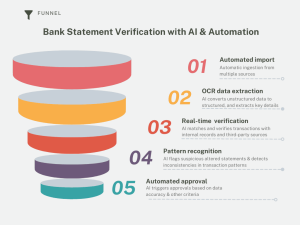
AI identity verification banking workflow using OCR and risk screening
Fragmented Onboarding Creates Compliance Friction
Manual processes consume skilled compliance capacity that could be directed toward higher-risk investigations. McKinsey reports that as much as 85% of financial-crime compliance and AML activity can remain administrative or non-analytical.
The problem often starts with disconnected systems. Staff may collect identity data in one application, perform screening elsewhere, and manually transfer information into a case-management process.
Poor data quality makes this problem worse. Fragmented sources and inconsistent structures can prevent investigators from connecting identities, transactions, and previously cleared parties.
eKYC and AML AI solutions should therefore address more than document processing. Banks need an operating model that improves data quality, prioritizes review effort, preserves audit evidence, and routes uncertain cases to trained teams.
Human oversight remains essential. AI can extract information, assign risk signals, and prioritize cases, while compliance teams retain control over exceptions and higher-risk decisions.
Four Building Blocks for Automated Customer Onboarding
A reliable automated customer onboarding model connects identity capture, risk assessment, AML controls, and human review. Each stage should produce information that the next stage can use without repeated manual entry.
Step 1: Capture and validate identity data
Start with structured digital capture. OCR can extract names, dates of birth, identification numbers, addresses, and other required fields from submitted documents.
The workflow should identify unreadable images, missing fields, expired records, and inconsistent information before deeper checks begin. Early validation prevents avoidable exceptions from moving further into the process.
Step 2: Apply AI-assisted identity and fraud checks
The next stage evaluates whether submitted information is consistent with the available evidence. AI models can detect anomalies and assign risk signals for additional examination.
Uncertain evidence should not become an automatic approval. Banks need defined thresholds for escalation, documented reviewer actions, and controls around model outputs.
Step 3: Connect identity checks with AML screening
Verified identity data should flow directly into relevant AML controls. These can include sanctions screening, politically exposed person checks, watchlists, and internal risk scoring.
The objective is not to replace existing compliance responsibilities. It is to provide richer information earlier, so investigators can spend more time on cases with meaningful risk signals.
Advanced analytics can make a material difference. McKinsey reports that data aggregation, statistical modelling, and automation can reduce false-positive alerts from above 90% to below 50% in applicable AML programs.
Step 4: Automate lower-risk decisions while retaining human oversight
Lower-risk applications can move through predefined controls with limited intervention. Exceptions should reach reviewers with the relevant evidence, risk indicators, previous checks, and decision history visible together.
This design makes eKYC and AML AI solutions easier to govern. Every automated action should have a clear decision rule, audit record, and escalation path.
Banks should also define governance before expanding automation. Model ownership, access controls, data retention, privacy requirements, and change approval should be clear before production use.

banking compliance analyst reviewing AI identity and AML risk signals
Measure Speed, Control Quality, and Compliance Workload
Banks should judge eKYC and AML AI solutions through business and compliance outcomes rather than model accuracy alone. A useful scorecard separates four categories.
Speed metrics show whether onboarding becomes easier for legitimate applicants. Track average onboarding time, document-processing time, and exception-resolution time.
Workload metrics reveal whether automation actually reduces manual effort. Monitor straight-through processing, manual-review rates, cases per investigator, and repeated data-entry tasks.
Control-quality metrics measure whether efficiency weakens or improves risk detection. Relevant measures include false-positive rates, escalation rates, failed verification rates, and meaningful investigation rates.
Governance metrics indicate whether the process remains defensible. Banks should track audit coverage, unresolved exceptions, model changes, reviewer overrides, and access-control violations.
CMC APAC can support these initiatives through our AI Services capabilities. The public service page covers Computer Vision for visual data processing and text extraction, alongside data science capabilities for fraud detection.
Our approved capability library also covers OCR and eKYC within Computer Vision. A Singapore BFSI AI engagement in our approved evidence bank achieved 100% secure on-premise deployment; this demonstrates deployment security rather than an eKYC performance result.
Frequently Asked Questions
What is the difference between eKYC and AML?
eKYC verifies a client’s identity through digital processes. AML controls assess financial-crime risk using identity, screening, transaction, and other relevant risk information.
How does AI identity verification work in banking?
AI can extract document information, assess image quality, identify inconsistencies, and route uncertain applications for additional review. Human oversight remains important for ambiguous and higher-risk cases.
Can automated customer onboarding still include human review?
Yes. Banks can automate defined lower-risk checks while directing exceptions to trained reviewers. The operating model should state which risk levels and decisions require human approval.
How can banks reduce AML false positives?
Better data is an important starting point. Banks can also refine risk segmentation, connect fragmented data, and apply analytics that help investigators prioritize stronger risk indicators.
What should banks measure when implementing eKYC and AML AI solutions?
Banks should measure onboarding speed, straight-through processing, manual-review workload, false positives, exception-resolution time, and audit coverage. Together, these measures show whether automation improves both operations and control quality.
Secure AI Makes Faster Banking Onboarding Sustainable
Faster onboarding only creates lasting value when identity checks, AML controls, human review, and audit evidence operate as one process. Banks should therefore measure AI against both processing efficiency and the quality of their financial-crime controls.
At CMC APAC, we support this model with AI capabilities covering Computer Vision, OCR, eKYC, and fraud-focused analytics. Through CMC, we also bring security credentials including ISO 27001:2022, ISO 27701:2019, SOC 2 Type II, and PCI DSS compliance.
To identify where secure AI can improve your onboarding process, discuss an AI onboarding assessment with CMC APAC.